Agentic Engineering / October 2026
AI Slop vs AI Craft
How you use AI on a task makes a big difference: in how you reach the solution, and in whether you can own it afterwards.
Two people can use the same AI model for the same task and finish with very different work. The prompt matters. So do the decisions before generation and the checks after it.
I find it useful to compare two ways of working. These are simplified illustrations, not the results of a controlled experiment.
Prompt and pray
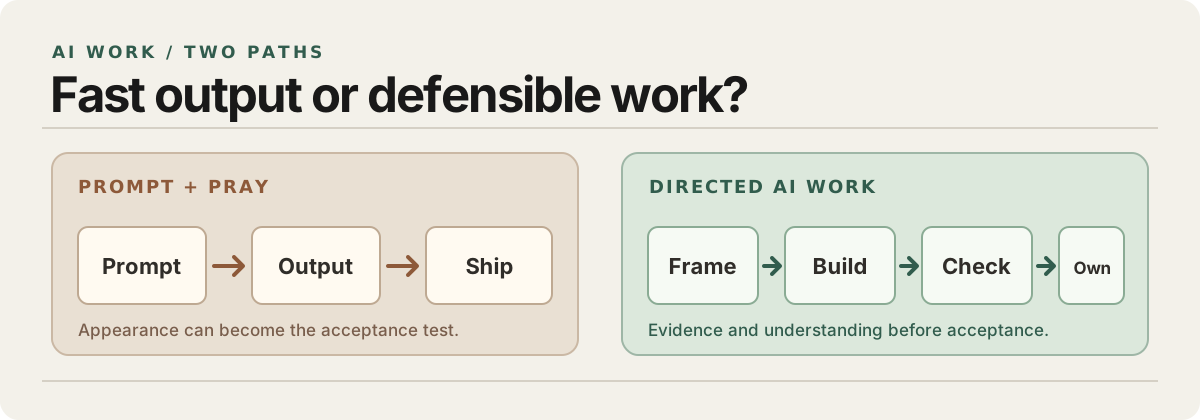
The task arrives. Give it to AI. Tell it to be thorough and avoid mistakes. Read the result, adjust a few sentences or lines, and ship it.
Prompt and pray
- Task
- Broad prompt
- First output
- Minor edits
- Ship
Important assumptions may remain unchecked.
Sometimes that is enough for a small task. The problem begins when a polished result is accepted without checking the claims that matter. A convincing explanation can hide an assumption. A working demonstration can miss the actual requirement. A passing test can exercise the wrong behavior.
By “slop,” I mean work whose appearance has received more attention than its substance. AI makes that easy to produce quickly. It also gives us ways to examine and improve it.
Directed AI work
Start with the problem. Who needs the result? What would make it useful? What constraints matter? Discuss options with AI, then choose a direction and define what would justify acceptance.
Break the work into pieces where that helps. Let agents research, implement or compare within clear boundaries. Inspect the result. Challenge important assumptions. Use tests where behavior can be checked, source evidence where claims need support, and human judgment where the trade-off belongs to a person.
Directed AI work
- Task
- Clarify
Define the outcome and what makes it useful.
- Strategy and constraintsHuman decision
Choose a direction, scope and acceptance bar.
- Bounded execution
Let agents work within that scope.
- Review and evidence
Evidence sufficient? Yes → continue.
No → improve and repeat execution. Changed requirement → return to Clarify.
- Understand
Can I explain the important decisions? Yes → continue.
No → learn and check again. Design problem → return to Strategy and constraints.
- Human acceptanceHuman decision
Accept → done: record evidence and ownership.
Revise → return to Strategy and constraints.
Human decisions can occur throughout the work when scope, authority or risk changes.
This is a loop. A failed check sends work back for correction. A misunderstanding may send me back to the requirements. A new scope or risk decision needs my attention. “Done” means the result meets the real bar, with enough evidence and understanding to take responsibility for it.
That does not require a fleet of agents for every task. A short factual answer might need one source check. A consequential software change needs more. Every extra step should answer a useful question.
The step I do not want to skip
Use AI to understand what it helped produce.
In a side project, it is easy to reach a point where the result looks convincing but I cannot yet explain an important decision. That is the moment to slow down, ask for a concrete explanation and reconstruct it in my own words.
This is comprehension catch-up. Recognizing the terms is not enough; I need to understand the choice and its consequences.
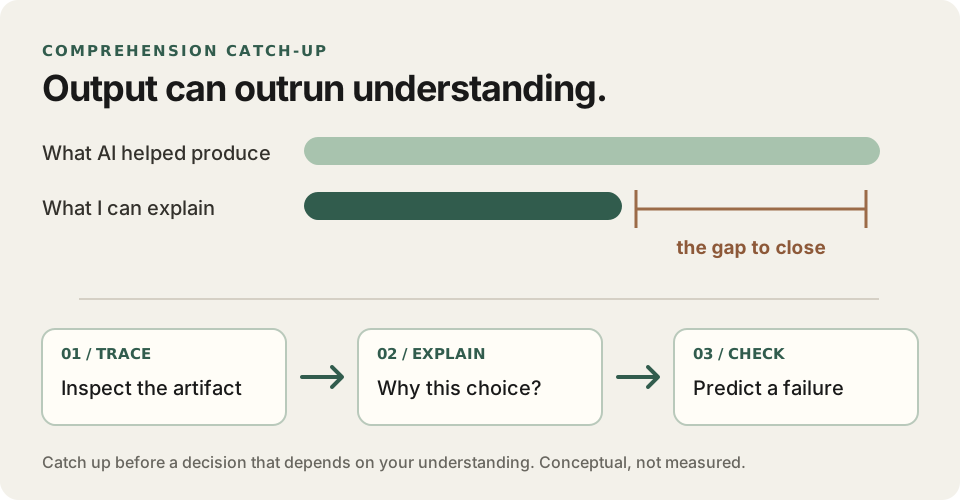
For a piece of software, the equivalent might be tracing one request, explaining a design choice or predicting what happens when a dependency fails. For a report, it might be reconstructing the argument from its sources and explaining its uncertainty.
An agent's explanation is a starting point. I still need to check it against the artifact or evidence. And if a gap affects whether it is safe to proceed, the learning has to happen before that decision.
What makes the work mine
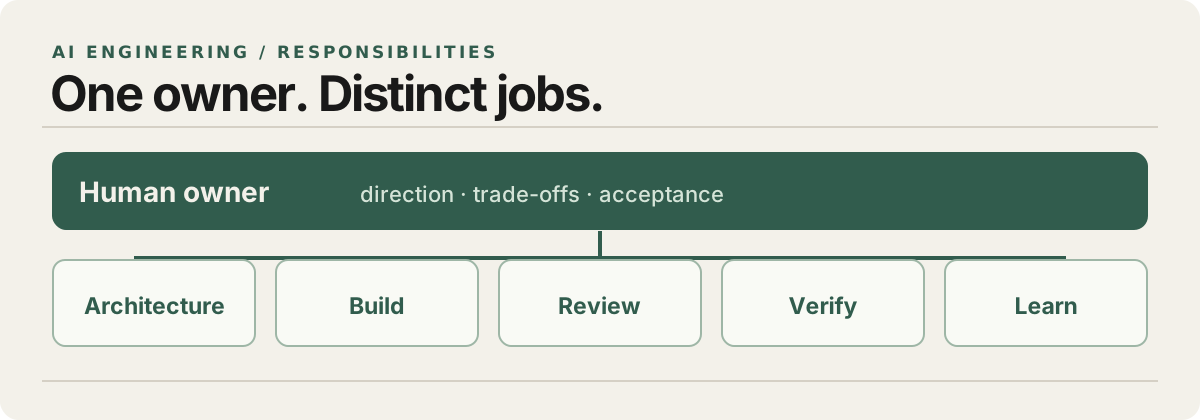
I do not need to pretend that the AI contribution was small. I do need to be clear about my contribution: framing the problem, choosing the approach, directing execution, examining the result and owning the decision to accept it.
That means being able to defend the important choices, including to somebody who did not watch the process. A customer needs a useful outcome and an honest explanation of what it does, where its limits are and how I know.
For the next task, I would start with three questions: What would make this good? What evidence would show that? What do I need to understand before accepting it?
Those questions are the practical entry point to my AI Working Framework. The framework keeps the broader habits visible: attention, consolidation, comprehension and a confidence process proportionate to the work.