Radio / mesh / June 2026
Meshtastic: My Small Off-Grid Mesh Network
What Meshtastic is, the devices I use, how my setup evolved, and why the mesh itself is more interesting than any single radio.
I started with one cheap LoRa board in a 3D-printed case.
Now I have a small collection of Meshtastic devices: a DIY ESP-based node, a few battery-powered handhelds, a Heltec MeshPocket that I carry with me, a fixed node at home, and a solar RAK4631 node for extending coverage.
That evolution is probably the easiest way to explain why I like Meshtastic.
It is not just a gadget.
It is a small radio network you can actually understand, build, move around, and improve yourself.
What is Meshtastic?
Meshtastic is an open-source messaging system built on LoRa radios.
The important part is that the nodes form a mesh.
Your phone usually connects to your Meshtastic device over Bluetooth. The Meshtastic device then talks to other Meshtastic nodes over LoRa.
If another node is in range, it can relay the message farther.
So instead of thinking:
phone → cell tower → internet → phone
you can think:
phone → my Meshtastic node → another node → another node → destination
No SIM card is needed for the mesh itself.
No mobile subscription.
No internet connection is required for the radio network to move messages.
Of course, LoRa is not a replacement for normal mobile data. It is low bandwidth. You are sending short messages and telemetry, not watching YouTube.
But that is also what makes it interesting: very low power, long range, and simple hardware.
Public mesh and private conversations
Meshtastic can be used as a public community network, but that does not mean every conversation has to be public.
There are public channels where nearby users can talk and discover that other nodes exist.
There are also private channels protected with their own encryption keys.
That means I can use the same radio network for two different things:
- participate in the wider local mesh
- keep private conversations private
The mesh can relay encrypted traffic without the relay nodes needing to understand the content.
That is one of the cooler parts of the design.
A node in between can help move your message without being part of your private conversation.
My first node: ESP and a 3D-printed case
My first Meshtastic device was exactly the kind of device I usually build first: an ESP-based LoRa board in a case I printed myself.
Cheap board, antenna, battery, printed enclosure.
It is still a good way to start.
ESP32 LoRa boards are inexpensive and easy to experiment with. Many have a small OLED screen, USB, Wi-Fi, and plenty of examples online.
The disadvantage is power consumption.
For something sitting on a desk or plugged into power, that is not a big problem.
For something you want to carry for days, it starts to matter.
Still, I like that node because it was the device that got me into the network in the first place.
Then I started using ready-made devices
After the DIY phase I bought a few devices with built-in batteries.
That changed how I used Meshtastic.
A homemade node is fun.
A finished node is something you just throw into a bag.
The one I use most now is the Heltec MeshPocket.
It is based on a low-power nRF52 platform with a LoRa radio, has an e-ink display, and comes with a large built-in battery.
What I like most is that it is also useful as a power device.
I carry it with me anyway, so I get both:
- a Meshtastic node
- portable power
That makes it much more likely that I actually have the radio with me when I need it.
For me, that matters more than having the most exotic hardware.
The cheap AliExpress node
I also bought one of the inexpensive Heltec-style LoRa/GPS kits from AliExpress.
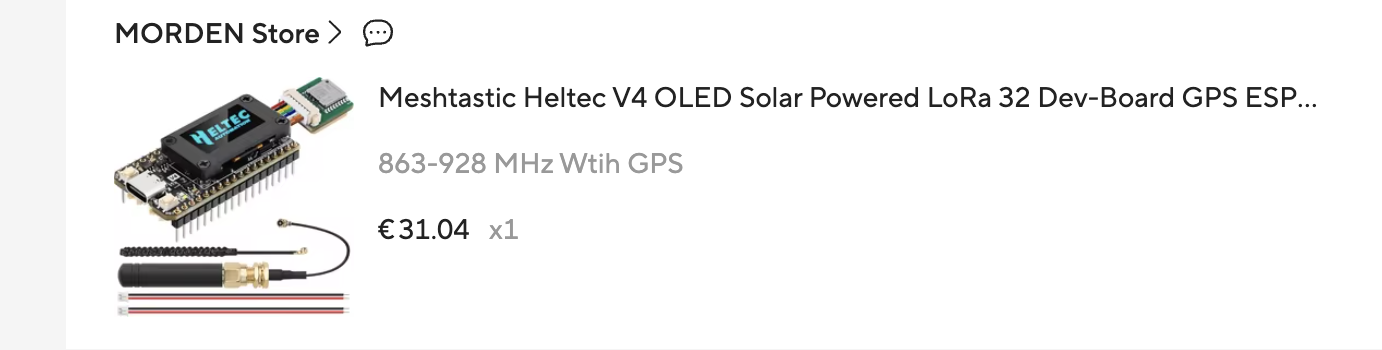
That end of Meshtastic is useful too.
It is cheap enough that you can experiment without thinking too much about it.
Try a different antenna.
Put it in another enclosure.
Leave one in the car.
Use it as another test node.
Build a temporary repeater.
Meshtastic has a nice hardware range, from very cheap development boards to polished handhelds and dedicated low-power outdoor nodes.
There is no one correct device.
It depends on what you want the node to do.
The home node is more important than it looks
The device I carry moves around with me.
The node at home does the opposite.
It stays in one good fixed position and gives me a stable connection into the local mesh.
That fixed node is important because radio coverage is heavily affected by location and height.
A better-positioned node can be much more useful than a more expensive handheld sitting low inside a house.
My home node expands the area where my mobile device can reach the mesh and acts as my permanent local point.
That is when Meshtastic stops feeling like two walkie-talkies.
It starts feeling like infrastructure.
The solar node
The next step was obvious: if a fixed node is useful, why should it need mains power?
I bought a D5 solar Meshtastic node based on the RAK WisBlock RAK4631.
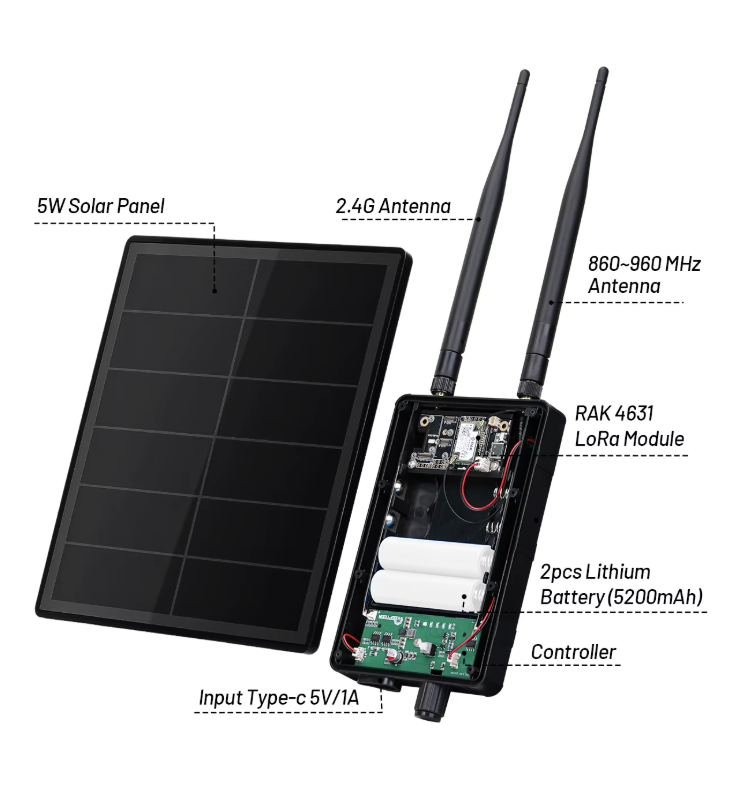
It has a small solar panel, batteries, an outdoor enclosure, and separate antennas.
The RAK4631 is a good fit for this because it is built around a low-power nRF52-class design with an SX1262 LoRa radio.
The point of the solar node is simple:
I can put it somewhere useful for radio coverage instead of somewhere convenient for a power cable.
That could be a roof, remote building, cabin, or another location with a better view.
For mesh networks, placement is often more important than raw transmitter power.
The cool part is the mesh
The hardware is fun, but the network is the part that keeps me interested.
Around Varaždin there is enough activity that my local mesh reaches much farther than a single direct radio link.
Through other nodes, the network extends toward Zagreb and north toward Graz.
That does not mean my handheld is directly transmitting to Zagreb.
That is exactly what the mesh is for.
Messages can hop through other nodes.
Each useful relay extends the network.
Split also has Meshtastic nodes, but as far as I can see it is currently a separate local island rather than connected to the northern mesh I use.
And that immediately makes you think about geography.
Where is the gap?
Would a node on a hill help?
Would one fixed solar repeater connect two areas?
Would moving an antenna five meters higher matter more than buying another radio?
It becomes a mix of networking, RF, power, and geography.
What I actually use it for
Most of the time I carry Meshtastic because I like having an independent communication path.
Normal mobile networks are obviously better for everyday communication.
Meshtastic is interesting because it does not depend on them.
It is useful for:
- short text communication
- location sharing
- trips and outdoor use
- experimenting with LoRa coverage
- keeping a private channel for my own group
- participating in the public local mesh
- learning how a real mesh behaves
And because the devices are low power, they can sit there for a long time doing their job.
The devices I use now
My setup has ended up with clear roles.
DIY ESP node
My original experimental node in a 3D-printed case. Cheap, flexible, and good for learning.
Battery-powered handheld nodes
The convenient devices. No enclosure design, no loose batteries, just charge and use.
Heltec MeshPocket
The node I carry most often. Low-power radio, built-in battery, display, and useful as portable power.
Home base node
Fixed at home in a useful position. It improves my access to the local mesh.
D5 solar RAK4631 node
The infrastructure node. Low power, solar powered, weather-resistant, and suitable for locations where I want coverage but do not want to run a cable.
That is really the whole story of my Meshtastic setup.
It started as one little radio in a printed box.
Then I wanted something easier to carry.
Then I wanted better fixed coverage.
Then I wanted a node that could stay outside without mains power.
And somewhere along the way, the interesting thing stopped being the device.
It became the network.