Agentic Engineering / October 2026
Introducing KiKo: From AI Agents to an Organizational Workforce
A good AI session can solve a problem, but I want that expertise to remain useful to the whole organization—and that's the idea behind KiKo.
I can open an AI chat, describe a problem, and get a surprisingly useful answer. With the right tools, I can even let an agent investigate, write code, run tests, or change a system.
But there's something about this workflow that bothers me: the useful thing often disappears when the session ends. The next person starts another conversation, provides the same context, explains the same constraints, and hopes for a similarly good result.
Companies have already spent decades learning how to avoid doing this with human expertise. We document procedures, build teams, assign ownership, maintain systems, and review changes. Why should AI expertise be treated as a collection of disposable conversations?
That's the question behind KiKo — Organizational Agent Platform.
I don't want an organization to collect clever prompts. I want it to accumulate useful, verifiable capabilities.
The idea grew out of working with AI agents
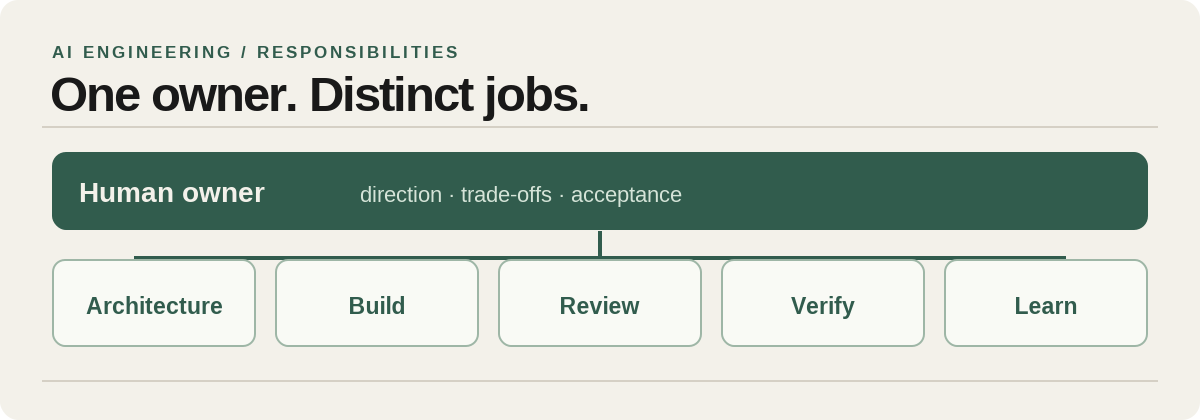
In I Don’t Use One AI: I Build an AI Engineering Team, I described how I separate architecture, development, review, and verification between specialized agents. It works better for me than asking one model to do everything and trusting the final answer.
Still, that approach exposes a larger problem. I can create an excellent development reviewer, but how does someone else discover and reuse it? How do I know which version produced a result? What if it needs access to a repository, a test environment, or a company's internal documentation? Who can change it? And how do we tell whether a change actually made it better?
Those aren't really prompting questions. They're systems engineering and organizational questions.
I have spent much of my career working with networks, telecommunications, infrastructure, and production systems. In those environments, an interesting demonstration isn't enough. I want to know who owns a component, what it's allowed to touch, how it behaves under failure, and how to recover when it goes wrong. I'm trying to apply the same thinking to AI agents.
One platform, many kinds of expertise
Imagine that a company has specialist agents for marketing, billing, provisioning, inventory, engineering, support, and operations. Some are created by technical teams; others start with people who know a business process better than anyone else.
Rather than living in separate chat histories or individual laptops, those agents have a common home. People can find the right specialist, understand its purpose, use it from their own work, and collaborate around it. An agent might appear in a chat window, an internal business application, or an automated workflow without becoming three unrelated copies.
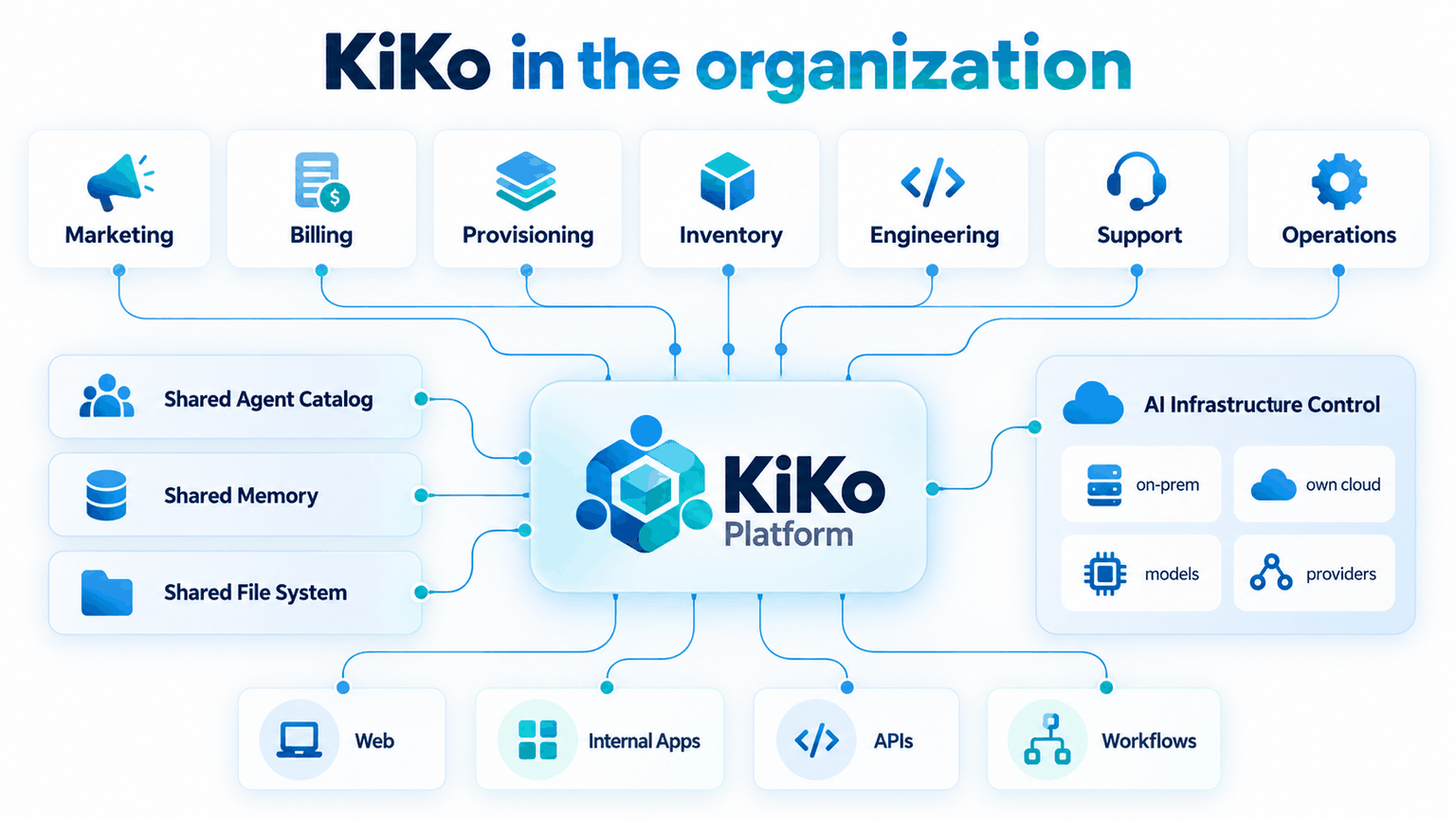 The KiKo concept: departments contribute specialists while shared knowledge, access and infrastructure remain governed.
This is what I mean by an organizational agent platform. The goal isn't to replace an organization with chatbots. It's to help the organization keep, reuse, and improve the useful AI capabilities it develops.
And there's an important distinction: a team of agents is not necessarily a chain where agent A calls agent B and then C. A team can be a durable collection of specialists that work independently, together, or only when needed.
An agent is more than its model
When someone says they've built an agent, they might mean a prompt with a name. That's a reasonable starting point, but it leaves most of the difficult questions unanswered.
For KiKo, I think of an agent as a managed digital coworker: a persistent role with a human owner, clearly defined responsibilities, and a set of capabilities.
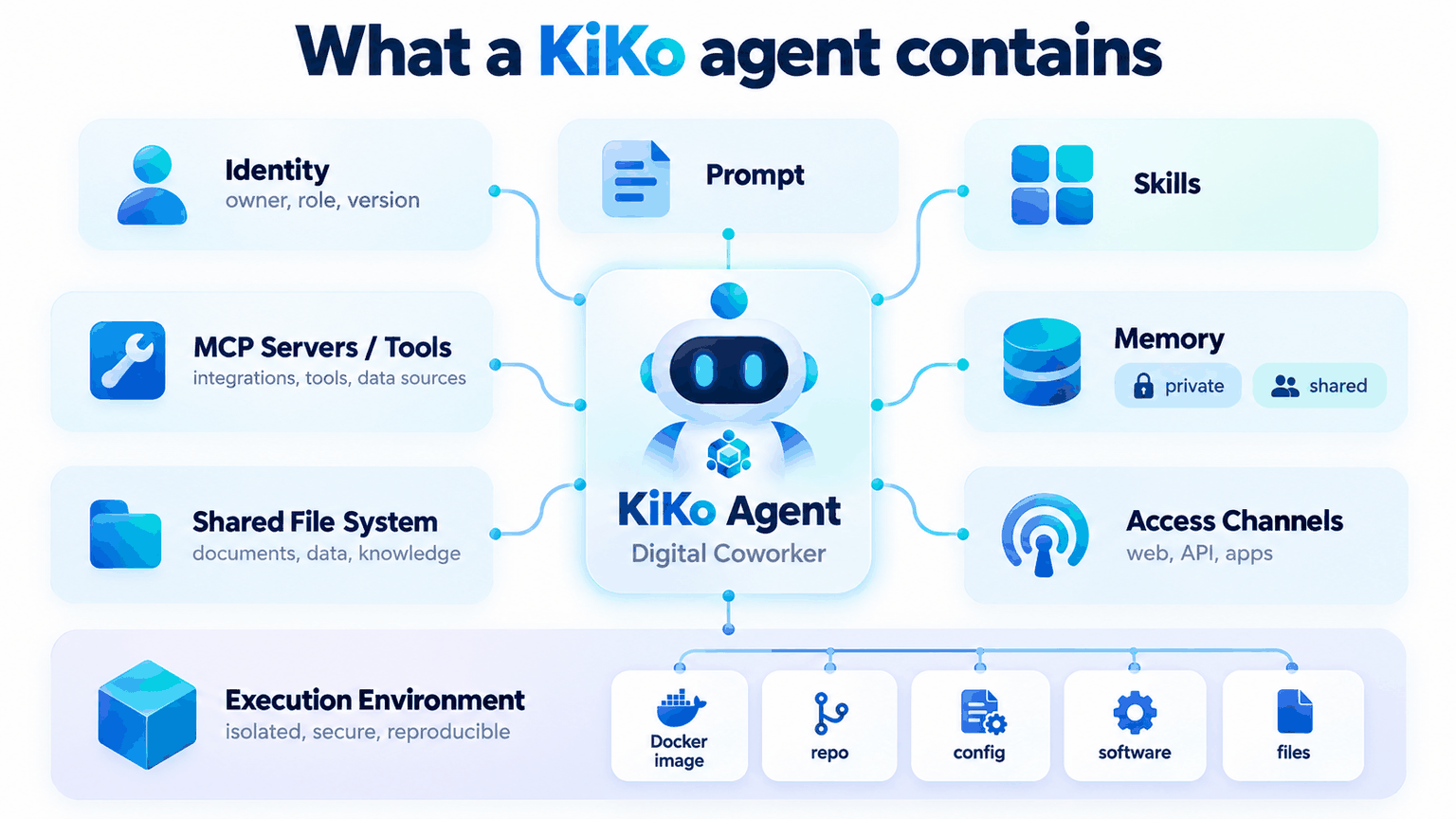 The model does the reasoning, but the surrounding system defines what the agent knows, can use, and is accountable for.
The pieces have different jobs. Instructions define responsibilities and limits. Skills package repeatable ways of working. Tools and MCP connections let the agent interact with approved systems. Knowledge and memory provide the context it is permitted to use. An execution environment provides software, configuration, a repository or other resources when the task requires them.
I also want a clean separation between the agent and its work sessions. The agent is the specialist; a session is one particular investigation or conversation. A session may last minutes or days. Ending it shouldn't mean the specialist itself ceases to exist.
That distinction matters because agents should be versioned, tested, owned, and published much like other internal software products. Changing an instruction, a tool, or a model can change behavior. A stable shared agent shouldn't silently change for everyone because its creator was experimenting.
A concrete example: a telecom customer problem
Here's the sort of business situation I have in mind. A customer calls because a service upgrade has been billed but isn't working. It's a familiar class of problem: the symptom appears in one department, while the explanation may span several systems.
A Support Agent looks up the customer case and identifies the affected service. A Provisioning Agent checks the intended service configuration. An Inventory Agent checks what resources are assigned. A Network Agent inspects the technical evidence. The Billing Agent checks whether the commercial state matches the service state.
They don't need unrestricted access to one another's data. Each specialist works with the tools, permissions, and knowledge required for its job. An agent can ask another specialist for an answer without inheriting all of that specialist's credentials.
The result isn't simply a polished paragraph. It could be a documented explanation of the mismatch, the evidence supporting it, and a proposed correction. If the correction changes a customer account or production network, an authorized employee makes the decision before any consequential action happens.
The business value is fairly ordinary, which is exactly the point: fewer repeated investigations, easier handovers, clearer ownership, and expertise that isn't lost when one person closes a browser tab.
The architecture behind the idea
I don't see KiKo as another AI model or a new interface to an existing model. I see it as the system around the models.
There are several layers to this idea:
- People and organization. Employees, teams, human owners, agent catalog, identities, permissions, and approval points.
- Agent definitions. Roles, instructions, skills, tools, model policies, versions, and rules for sharing.
- Control plane and sessions. A place to start work, route requests, preserve history, inspect outputs, and manage the lifecycle of agents and workers.
- Execution and integration. Isolated environments for work; MCP connections to approved applications and data; agent-to-agent communication where collaboration makes sense.
- Knowledge and artifacts. Scoped memories, documents, findings, files, evaluations, and their sources. A transcript is evidence of a conversation, not automatically verified knowledge.
- Models and infrastructure. Local models, external providers, or a combination, running on infrastructure the organization chooses to control.
I especially care about keeping these layers separate. A runtime can come and go while a logical session survives. A model can change without deleting the agent's identity or its history, although changing models always calls for retesting. And access control can't be a polite request inside a prompt: it has to be enforced by the platform and the connected systems.
This connects to something I argued in The Model Is Not the System. A capable model is valuable, but reliability also comes from deterministic controls, evidence, proper boundaries, and a way to inspect what actually happened.
Agents should participate in work, not just answer questions
A chat interface is useful, but real business processes don't always begin with someone typing a question.
An order may arrive. A monitoring system may detect an anomaly. A scheduled report may become due. Another agent may need a specialist's opinion. KiKo's design should let the same agent be invoked by these different entry points, perform authorized actions, and return results to the people or systems that need them.
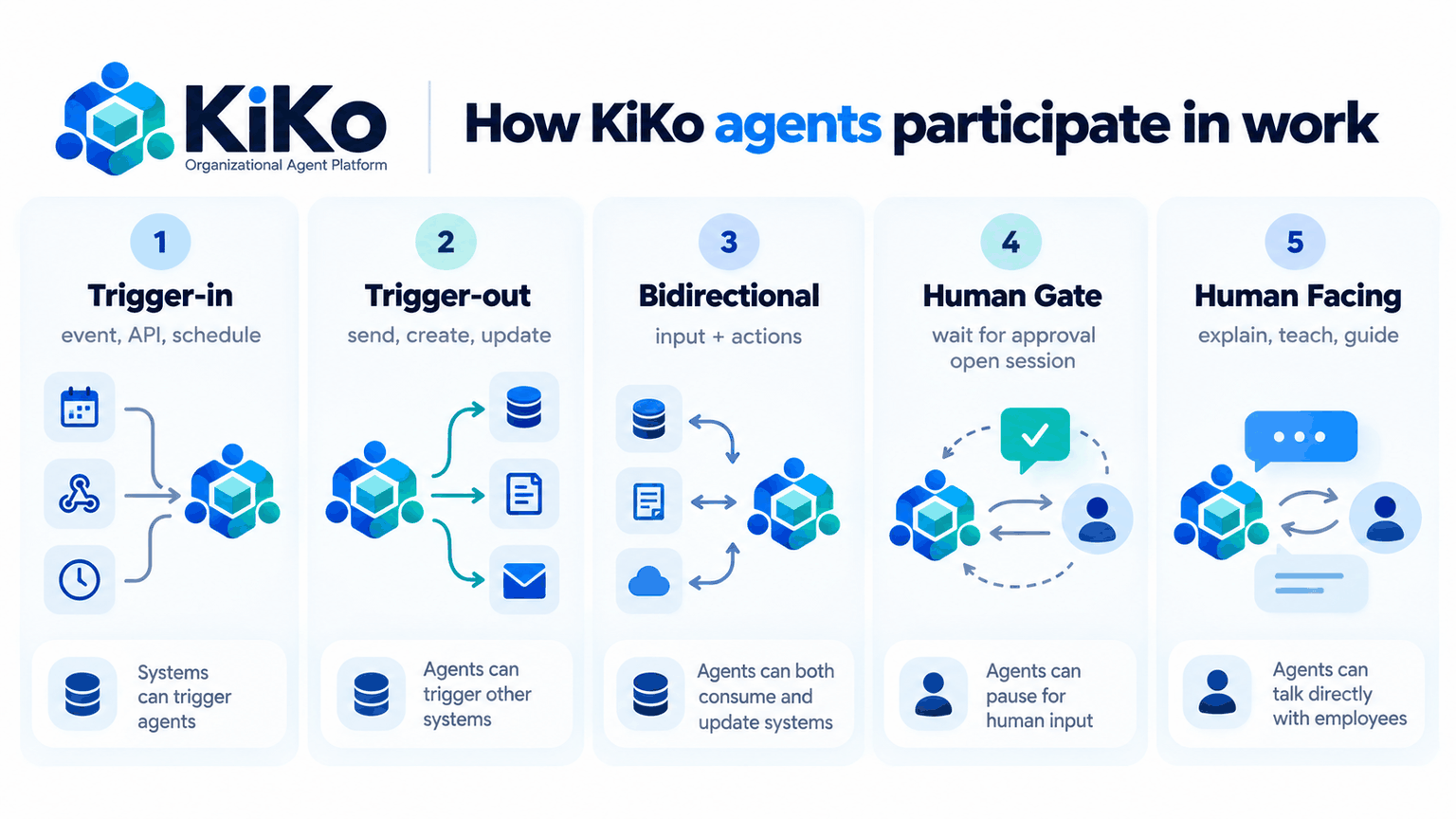 The same specialist can react to events, initiate authorized actions, exchange information, ask for approval, or explain its work to people.
The human gate is especially important. Not every step should be automated. Sometimes the best thing an agent can do is gather the facts, explain the options, and stop at precisely the right point for a person to decide.
From sessions to reusable organizational knowledge
This is probably the part of KiKo that interests me most.
Imagine spending several days with an agent investigating a complicated system. You explore false starts, document constraints, compare alternatives, test assumptions, and eventually develop a much better understanding of the problem. I don't want the outcome to be just another very long transcript.
I want that work to be something an organization can curate into a new specialist, with its responsibilities, relevant knowledge, boundaries, tools, and evaluation examples attached. The agent can then be reviewed, tested, and published for other people to use.
And I want the same discipline applied when the organization improves an existing team of agents. An analyst could examine completed work and recurring failures. An architect agent could propose a revised skill, a different team arrangement, or a better evaluation. But a proposal is not permission to deploy itself. A human owner should be able to understand the evidence, compare versions, approve the change, or reject it.
That's how a collection of experiments can begin to become an organizational asset: not through unchecked autonomous self-improvement, but through measured learning with accountable owners.
Who owns the infrastructure — and who owns the expertise?
There's another reason I'm drawn to this approach. I don't want the useful part of a company's AI practice to exist only inside a single provider's product.
KiKo is self-hosted-first in its design philosophy. An organization should be able to run the platform on its own servers or in its own cloud account, choose local or external models, and understand where its data goes. That doesn't automatically make all data private: sending a request to an external model or tool still crosses a boundary that must be visible and governed.
The more interesting portability question is not just can I swap one model for another? It is can I keep the agents, their responsibilities, their skills, the knowledge we've validated, and the record of how they evolved? Models will keep changing. The organizational capability should be more durable than any particular model endpoint.
The question I want to explore
I don't think the hard problem is creating more agents. We can already do that. The hard problem is making them reusable, accountable, safe enough to depend on, and more useful over time.
What does it take for an agent created by one employee to become a trustworthy internal tool for another? How should its quality be measured? What belongs in memory, and what should remain an unverified observation? Where should an automated workflow stop and a person take over?
KiKo is the name I've given to my attempt to explore these questions as one coherent system.
The guiding idea is simple: turn conversations into agents, agents into teams, and teams into a system that can learn without losing human ownership.
That's the direction I want to build toward.